Pilgrimage

We tend to think of pilgrimage as travel to historic holy places such as Jerusalem, Rome, Mecca, Lourdes, or Santiago de Compostela. However, pilgrimages often entail a significant inner spiritual journey as well.

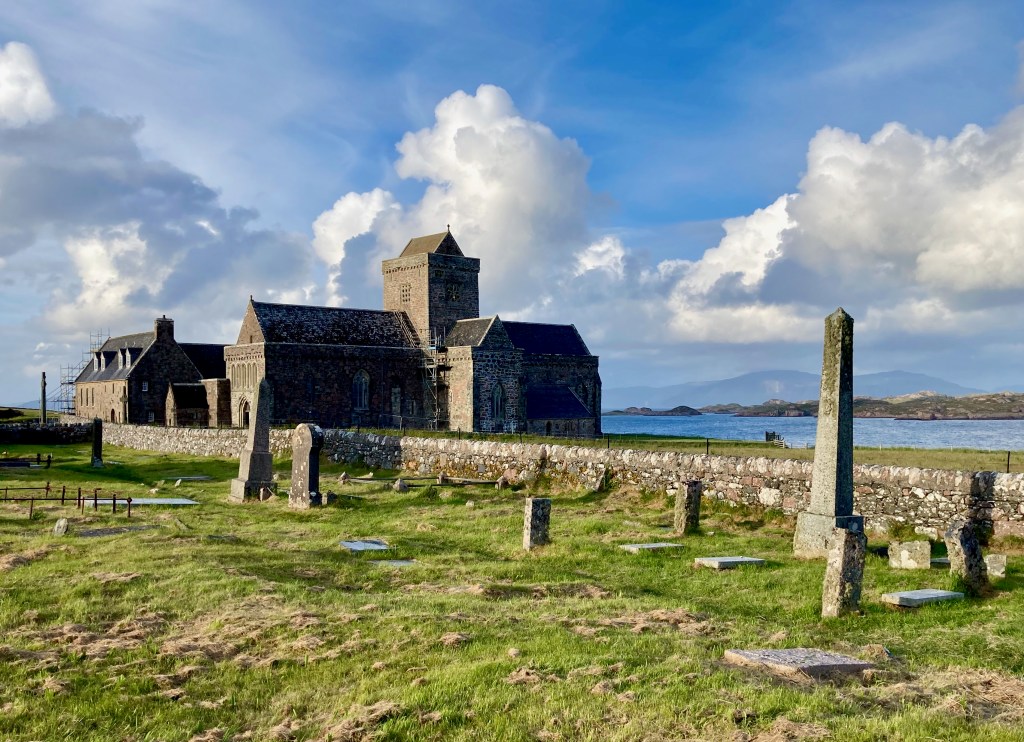
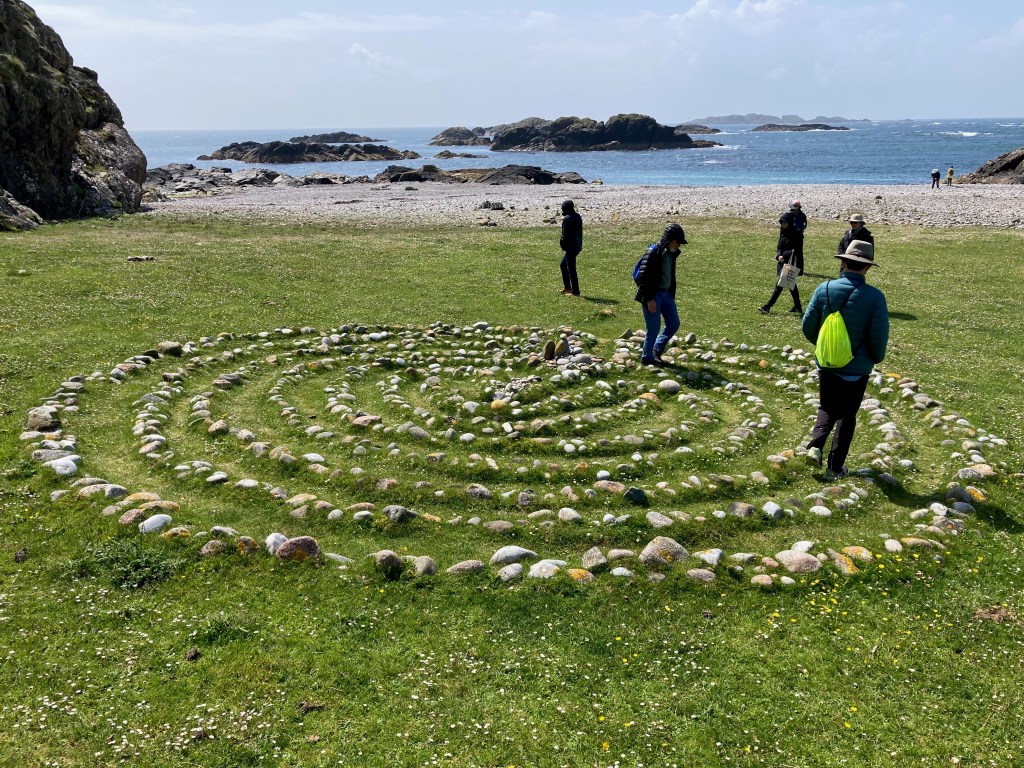
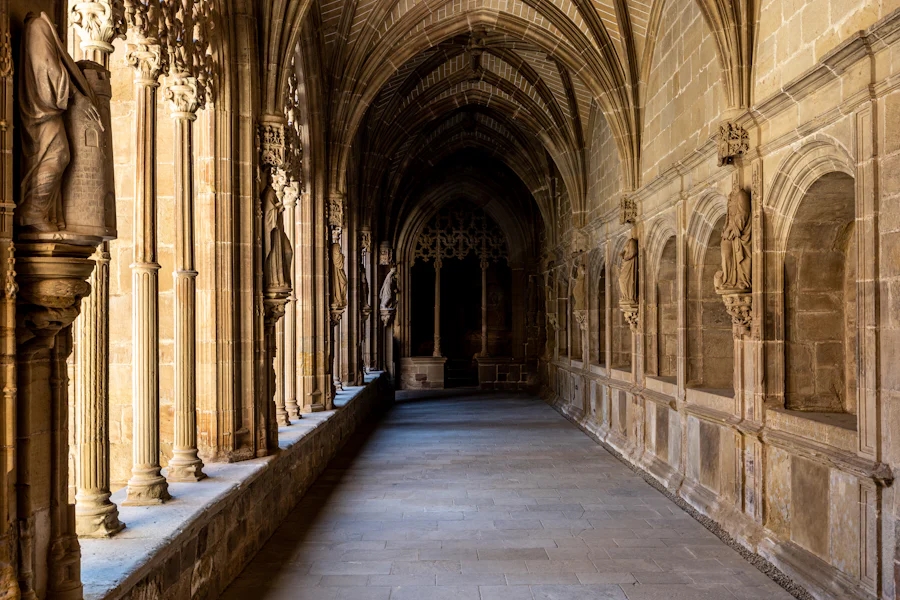
Mike and I just returned from such a pilgrimage to Iona, a small island in the Inner Hebrides off the northwest coast of Scotland. To get there requires a lengthy combination of planes, trains, buses, and ferries. Iona is where St. Columba landed in 563 CE with twelve of his most devoted monks, having left Ireland to establish a new monastic community. 

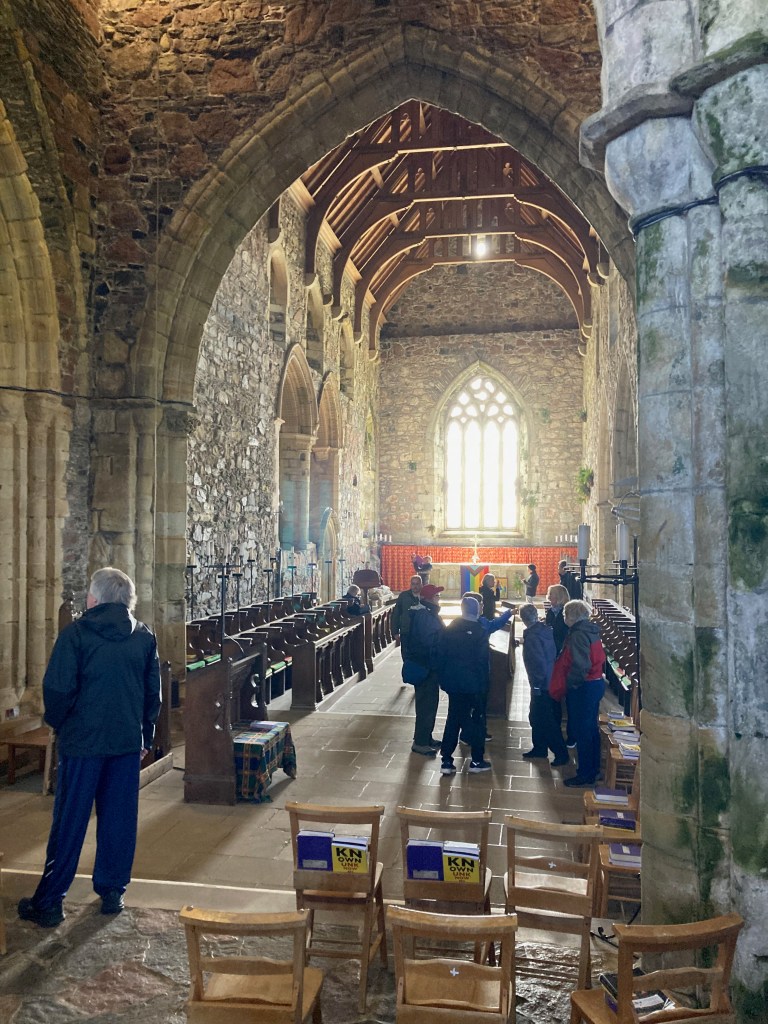
It became a renowned center of learning, and its scriptorium produced highly important documents, including the Book of Kells. Between 795 and 825 massacres occurred on Iona during several Viking raids of the island and its abbey, killing the monks who, without weapons, were defenseless. Beginning in about 1200, Benedictines built the existing stone abbey on Iona, although it was abandoned after the Protestant Reformation and fell into ruin. In 1938, the Rev. George MacLeod had a vision for restoring the abbey and creating again a faith community and center for spiritual formation on the island. 

For many, Iona exemplifies the ancient Celtic concept of a “thin place,” a place where the veil between heaven and earth is porous, nearly transparent, where the two worlds become almost one. One factor in its “thinness” may be the extreme beauty of the place. In Iona, as well as other places I’ve visited, I’ve been overwhelmed by the magnificence of God’s creation in a way that makes me feel God’s nearness. Another factor may be the place’s sense of sacred history. Iona certainly has this. As Bill Stone, one of our tour leaders said about the Abbey church, “These stones are soaked in prayer.”

But I realized, after warm, open-hearted interactions with the other pilgrims who were there, that the sense of heaven also comes from the Holy Spirit as it is evident in the lives of others. The lovely people I came to know created a thin place for me as they radiated the love of Christ. 

Pilgrimages to thin places like Iona are a reminder to us that we are sojourners here on earth, and that the kingdom of heaven is our home. Eventually, pilgrim, as W.H. Auden wrote, “you will come to a great city that has expected your return for years.”[1]


[1] W.H. Auden, For the Time Being: A Christmas Oratorio, 1944.

Ascension

“Ascension” by Malcolm Guite

We saw his light break through the cloud of glory
Whilst we were rooted still in time and place
As earth became a part of Heaven’s story
And heaven opened to his human face.
We saw him go and yet we were not parted
He took us with him to the heart of things
The heart that broke for all the broken-hearted
Is whole and Heaven-centred now, and sings,
Sings in the strength that rises out of weakness,
Sings through the clouds that veil him from our sight,
Whilst we ourselves become his clouds of witness
And sing the waning darkness into light,
His light in us, and ours in him concealed,
Which all creation waits to see revealed.

Malcolm Guite

Thanks to my Cornerstone sister, the Rev. Marianne Allison, for sharing this with us at our community gathering on May 9, 2024.

The Rewards of Hospitality

From the Rule of St. Benedict (Excerpt from Chap. 61)

If a pilgrim monk coming from a distant region wants to live as a guest of the monastery, let him be received for as long a time as he desires, provided he is content with the customs of the place as he finds them and does not disturb the monastery by superfluous demands, but is simply content with what he finds. If, however, he censures or points out anything reasonably and with the humility of charity, let the Abbot consider prudently whether perhaps it was for that very purpose that the Lord sent him.

Reflection *

The striking thing about this chapter of the Rule is the possibility that God sends visitors our way for a special purpose. God may send a visitor to the monastery to give the monks a “reasonable criticism or observation,” as three men (angels?) were sent to Abraham to tell him that he and his wife Sarah would have a son. They had difficulty believing the message because of their advanced age but, in fact, it turned out to be true.

This chapter sets a standard for both visitors and their host. First, visitors must not make excessive demands, but simply be content with what they find. Second, the host’s welcome should be genuine and generous, willing to receive the guest “for as long a time as he wishes.”

I find it much easier, as a guest, to honor the first expectation than I do, as a host, to honor the second. (Really? As long a time as he wishes?) Benedict even presents the possibility that the good guest should be extended an invitation to join the community.

The Genesis story of Abraham and his visitors goes even further in describing desert hospitality: washing the guests’ feet, bringing them bread and milk, and preparing a special meal. Benedict has more to say about hospitality in chapter 53 of the Rule, where, citing Matthew 25, he reminds us that “all guests who present themselves are to be welcomed as Christ.” 

* From Praying with Saint Benedict, Morehouse Publishing, 2021, p. 195-96

Atonement

Excerpted and edited from A Confirmation of Faith (Resource/Wipf & Stock)

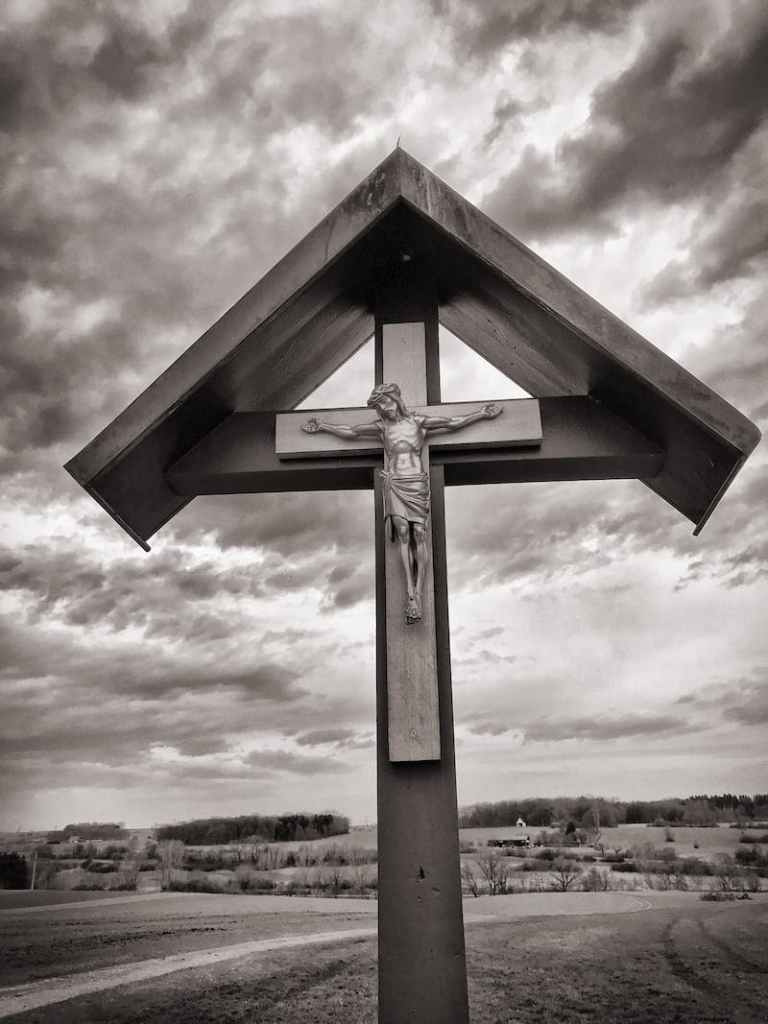
What is the meaning of Christ’s death? might be a question we ask ourselves as we approach Good Friday. On the one hand, traditional Christian teaching has been that Christ was our substitute on the cross to atone for the sins that we, God’s rebellious creatures, have committed. Paul tells us in Romans 6 that “the wages of sin is death.”

On the other hand, many have trouble with the anthropomorphic image of an angry, vengeful God who demands a blood sacrifice rather than a God who loves creation and is ready to forgive. One of my clergy friends (admitting that it is a radical theory) holds that Jesus was killed because he spoke truth to power, and it was only later that all the theories about atonement were created. However, scripture has many references to sacrifice as atonement for sin, both in the Hebrew scriptures (e.g., Lev. 5:6) and in the New Testament (Rom. 3:24).

Our liturgy, too, is full of references to Christ’s atonement for our sins (e.g., “Lamb of God, you take away the sin of the world.”). Cynthia Bourgeault makes the argument that God wasn’t angry. Yes, Jesus died for our sins, but he died on behalf of a collective fallen human condition. [1]

I think there is another possibility that addresses our individual as well as collective sin. Jesus died not because an angry God demanded it, but because humans, somewhere in our collective unconscious, demand atonement. Channeling God’s voice, Hosea wrote, “For I desire steadfast love and not sacrifice, the knowledge of God rather than burnt offerings” (Hos. 6:6). Karen Armstrong maintains that human sacrifice was common in the ancient world, even among the pre-Israel Canaanites. [2]

That same archetype from society’s collective unconscious is evident today in a predominantly punitive, rather than restorative, justice system. We demand harsh atonement for wrongs. Amnesty International recorded at least 1,477 death sentences in 54 countries in 2020—sometimes for acts that should not be criminalized. 

Perhaps, then, Christ offered himself as a sacrifice for the whole world not to appease God’s wrath over our sins, but to appease the human demand for atonement. In his sacrifice, he gave of himself in a way that said, “Okay, this is it. It is finished. I am giving my life for the sins of the world. No more sacrifice—animal or human—is required.” 

Furthermore, Christ’s death puts the seal on the fact that Jesus was fully human, experiencing all that humans experience, even to the extreme of suffering, torture, and death, what Cynthia Bourgeault calls “the sacramental necessity that Jesus drink to the dregs the full anguish of the human condition.” [3] 

And he went even further. He demonstrated by his resurrection that new and glorious life can arise from a fallen state.

I welcome your comments.

_____________________________

[1] Bourgeault, Cynthia. The Wisdom Jesus. Boulder, CO: Shambhala, 2008, 107.

[2] Armstrong, Karen. The Great Transformation. New York: Knopf, 2006, xv.

[3] Bourgeault, Wisdom Jesus, 118.

Lenten Reassurance

“Seven times in the day,” Benedict writes, quoting the psalmist, “I have rendered praise to You” (Ps. 119:164). In Chapters 17 and 18 of the Rule, Benedict goes on to specify the order of psalms to be said at the smaller offices throughout the day: Terce (mid-morning), Sext (mid-day) and None (mid-afternoon). “At Terce, Sext and None on Monday let the nine remaining sections of Psalm 118 be said” (Psalm 119 in the Masoretic numbering), “three at each of these Hours. . . Let the nine Psalms from Psalm 119 to Psalm 127 be said at Terce, Sext and None, three at each Hour, beginning with Tuesday.”

As C. S. Lewis and other authors have pointed out, many of the psalms are not comforting. The psalter contains psalms of complaining, judgment, and cursing as well as those of praise and comfort. However, Benedict has chosen a collection of reassuring wisdom psalms to be said at the little offices, beginning with Psalm 119. Psalm 120 begins, “When I was in trouble, I called to the Lord . . . and he answered me.” Psalm 121 is a comforting favorite of many. Many times, as I approach my favorite place of worship, I remember the words “I was glad when they said to me, ‘Let us go to the house of the Lord’ ” (Psalm 122). 

Psalm 125 tells us that “Those who trust in the Lord are like Mount Zion, which cannot be moved, but stands fast forever.” And this collection ends with Psalm 128 (Psalm 127 in Benedict’s Septuagint Bible): “Happy are they all who fear the Lord, and who follow in his ways!” The path of discipleship isn’t always easy, and in the monastic day of prayer and work, work and prayer, psalms such as these offered important reassurance. Happy are those who fear the Lord and follow in his ways.

Prayer

Steadfast God, thank you for the reassurance that you are watching over us, by day and by night. Help me always to look to you, trust in you and, with gratitude, follow you. Amen.

Scholastica

Today is the feast day of St. Scholastica, Benedict’s twin sister. The two siblings were born around 480 to a Roman noble family in Nursia, Italy. Although little is known of her early life, she founded a religious community for women five miles from Monte Cassino where her brother was abbot.

Following her brother’s example of total dedication to the Lord, she joined a small community of pious virgins and eventually founded a monastery of nuns not far from Benedict’s own monastery. 

    In his biography of Benedict, Pope Gregory wrote that the two used to meet once a year at a farmhouse situated halfway between the two communities because Scholastica was not permitted inside the male monastery. They spent their time together in prayer and discussion of spiritual matters. Benedict seems to have directed his sister and her nuns, most likely in the practice of the same rule by which his own monks lived. However, I like to think that Benedict’s more gentle and balanced guidelines for leadership and discipline may, in fact, be due to this feminine influence in his life. 

    A story is frequently told about their last visit together. They passed the time as usual in prayer and conversation — after which Scholastica begged her brother to remain for the night, but he refused. His Rule required him to return to the monastery before night. 

    Immediately there arose such a storm that neither Benedict nor his fellow monks could leave. Benedict complained to his sister, “God forgive you, what have you done?” He had no choice but to stay and talk to his sister about spiritual matters throughout the night. Three days later in the year 543, Scholastica died. 

Abbey of St. Scholastica

Prayer

We pray, O Lord, that, following Scholastica’s example, we may be diligent in our prayer, serve you with pure love, and happily receive what lovingly comes from you. Amen.

Epiphany

The Christian feast of Epiphany primarily commemorates the visit of the Magi to the Christ child, which in turn represents Christ’s physical manifestation to the Gentiles. It is also sometimes called Three Kings’ Day or Little Christmas. In the Orthodox Church, Epiphany is known as Theophany and commemorates Christ’s baptism by John in the Jordan River.

The everyday meaning of the word epiphany has come to mean a revelation, or a sudden intuitive perception or insight into the essential meaning of something.

What are the factors that lead to an epiphany?  Certainly, the Holy Spirit has a part in revealing to us the true meaning of a thing through something we hear, or read, or have been thinking about. The three Magi were actively searching for the meaning of the star. But are we actively looking for Christ and a recognition of the Divine in our lives? 

Quoting from the book of Romans and the Psalms, the Rule of St. Benedict (Prologue) tells us, “Let us arise then, at last, for the Scripture stirs us up, saying, ‘Now is the hour for us to rise from sleep.’ Let us open our eyes to the deifying light, let us hear with attentive ears this charge which the divine voice cries daily to us, ‘Today if you hear His voice, harden not your hearts.’ ”

We are hardly prepared to receive an epiphany if we aren’t paying attention, or “listening with the ear of our heart,” as Benedict would put it. 

I tend to be somewhat earthbound, absorbed in the mundane things going on around me in my day-to-day existence. It is my prayer to be more awake to the presence of God in my life throughout the day. 

Prayer

Patient and ever-present God, thank you that you call me to a new life in Jesus Christ. Awaken me from a passive half-awake faith, and help me to eagerly respond to your call. Let me listen to your voice and open my eyes to your light. Amen.

Silence and Stillness

I recently recorded a podcast for Trinity Cathedral’s Advent series, Reverberation of the Spirit. In the busy-ness of Advent, we can easily forget that Advent is about waiting, anticipation. And that requires a centeredness and stillness that allows us to truly appreciate the significance of Christ coming to earth. Stillness requires silence, moments when we can cut out the noise that surrounds us as we go about in the world. Listen to the podcast here.

Praise and Thanksgiving

From the Rule of St. Benedict (Ch. 13): 

“On weekdays the Morning Office shall be celebrated as follows. Let Psalm 66 be said without an antiphon and somewhat slowly, as on Sunday, in order that all may be in time for Psalm 50, which is to be said with an antiphon. After that let two other Psalms be said according to custom . . .”

One of my former priests once told me that she had a friend who, as a daily practice, did not speak after rising in the morning until she had said, “Lord, open my lips and my mouth shall proclaim your praise.” I thought that beginning the day by asking God to sanctify your lips and words was a great idea. 

The practice of using psalms to begin the day with praise comes right out of the sixth century Rule of St. Benedict. The rite of Morning Prayer, still practiced today in the church, begins “Lord, open my lips and my mouth shall proclaim your praise.”

Praise forms a major part of morning worship, as Benedict described it in the Rule. Although he laid out an order of worship in which different psalms are chanted each day, Psalm 50 seems to be a constant, and one that Benedict didn’t want anyone to miss. Psalm 50 is the one that begins: “The mighty one, God the Lord, speaks and summons the earth from the rising of the sun to its setting.” 

It ends: “Those who bring thanksgiving as their sacrifice honor me; to those who go the right way I will show the salvation of God.” In other words, the psalm begins by speaking dramatically of God’s power and concludes by saying that the best sacrifice we can offer God is the gift of thanksgiving. Making a habit of daily praise and thanksgiving develops in us a salutary spirit of gratitude, being thankful for our life and for all God has given us. 

Prayer

Mighty God, I acknowledge your power and sovereignty. Thank you for my life with all its joys and challenges, and for all you have made and all you have given me. Amen.

Servanthood

“Let the brethren serve one another, and let no one be excused from the kitchen service except by reason of sickness or occupation in some important work. For this service brings increase of reward and of charity” (RSB 35). 

I just finished doing the dishes. I grew up having to take my turn washing dishes, a job I didn’t always enjoy. But the Rule of Benedict changed my attitude about tasks such as this. Our word minister comes from the Latin minister and the Old French menistre, which means servant, as in valet or one who serves tables. According to the Benedictine principle of ora et labora (prayer and work), physical labor done for the benefit of others is sacred too. 

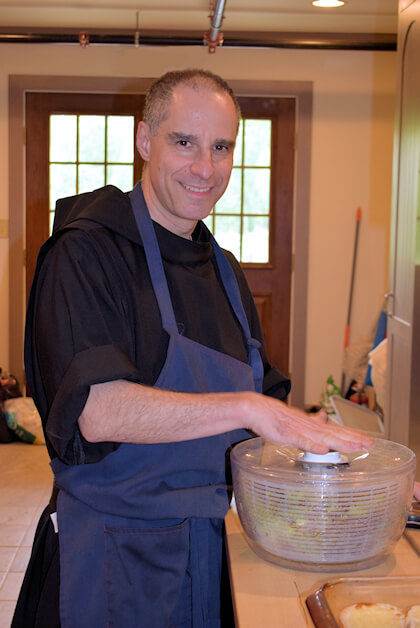
One salient memory of my visits to the monastery is seeing the monks serving each other and their guests during the midday meal, the largest meal of the day. The servers wore aprons and special sleeves that protected the cuffs of their cassocks as they brought trays and bowls of food to each table, allowing each person to take as much as they needed, and giving a slight bow of their head at the end of their silent interaction. As the monks and guests ate in silence, the servers cheerfully went about their tasks as if they truly enjoyed their duty. I learned that other monks were assisting the cook in the kitchen. 

OLYMPUS DIGITAL CAMERA

At the end of one meal, I was especially impressed that the abbot himself rose, leaving the abbot’s table, and joined others who were clearing away the dishes and table service. In this simple act of service, the monks were following Christ’s own example. Jesus himself, the very Son of God, humbled himself and became a servant, feeding his disciples and washing their feet.