Vows

From the Rule: “Those who are to be received shall make a promise before all in the oratory of their stability, their reformation of life, and their obedience . . .” (RSB 58).

Reflection from Praying with Saint Benedict:

Three promises are made when novices take their vows: stability, obedience, and reformation of life. (Other translations of the Rule transcribe the original phrase conversio morum—or conversatio—as “conversion of life” or “conversion of morals.”)

In my Benedictine community, we define these three vows this way:

• Stability is the promise to remain in community, even though close relationships can create interpersonal tensions, and to stay faithful to our practice.

• Conversion of Life is a commitment to practice the ideals of scripture and the Rule to sanctify everyday living, acknowledging spiritual transformation.

• Obedience is responding with deference to the abbot and others in the community and accepting the example of Jesus to seek what is best for others.

The three promises are interrelated. Stability is an act of obedience to the community, and reformation of life empowers us to be both more stable and more obedient. In other orders, monastics also take vows of chastity and poverty, but Benedict saw these as outcomes of a conversion of life and obedience.

All of the interpretations refer to one’s manner of living. In a monastery, this change of life is indicated in the novices’ final symbolic act: putting aside their own clothes and taking on the wardrobe of the monastery.

As Michael Casey points out, conversion is a necessary starting point for the spiritual journey as well as a necessary device to bring us back on course when we have drifted away. And it is a gift of grace. We cannot bring it about through our own efforts. God calls out to us, and we respond by reorienting our lives to grow into the kind of person God created us to be. We change because we can do no other.


M. Casey, The Road to Eternal Life (Collegeville, MN: Liturgical Press, 2011), 6–7.

S. Isaacson, Praying with Saint Benedict: Reflections on the Rule. (New York: Morehouse, 2021), 8-9.

Lent as Life

From the Rule of St. Benedict (Ch. 49)

The life of a monastic should have about it at all times the character of a Lenten observance. Yet since few have the virtue for that, we therefore urge that during the actual days of Lent the community keep their lives most pure and at the same time wash away during these holy days all the negligences of other times. And this will be worthily done if we restrain ourselves from all vices and give ourselves up to prayer with tears, to reading, to compunction of heart and to abstinence. During these days, therefore, let us increase somewhat the usual burden of our service, as by private prayers and abstinence from food or drink. Thus, everyone of their own will may offer God “with joy of the Holy Spirit” (1 Thess. 1:6) something above the measure required of him.

Reflection

What should I give up for Lent? Benedict makes the point that all of our life should manifest the abstinence and restraint of a Lenten observance.

Isn’t restraining ourselves from sinful habits and giving ourselves to prayer, reading, and compunction of heart a good thing to practice year-round? What is the point of giving up chocolate or alcohol, as a token sacrifice, intending that we will take it up again the minute Lent is over? What is the point of giving up something we can do without while still being lax in our habits of prayer and study and service to others? Laura Swan wrote, “God hands us our asceticism through the normal circumstances of everyday life.” [1]

Benedict suggests that during Lent we increase the “usual burden of our service,” perhaps by praying more faithfully or volunteering for that ministry we have felt called to join, as well as restraining ourselves with greater intention from food and drink we don’t need. He further says we should do this of our own will, offering it to God with the “joy of the Holy Spirit.” In other words, Lent should be joyfully observed. We don’t do this to earn points with God, but rather out of deep gratitude for God’s grace to us.

Prayer 

Gracious God, thank you for the joy of your Holy Spirit and the grace that inspires me to be intentional about all the things that are good for me and bring joy to others. Amen

_____________________

  1. Laura Swan, Engaging Benedict. (Notre Dame, IN: Ave Maria Press, 2005), p. 108.

St. David of Wales

David of Wales was a renowned preacher and missionary who founded monastic settlements and churches in Wales, Brittany, and southwest England. According to legend, he was born on a Pembrokeshire clifftop during a fierce storm in 500 CE.

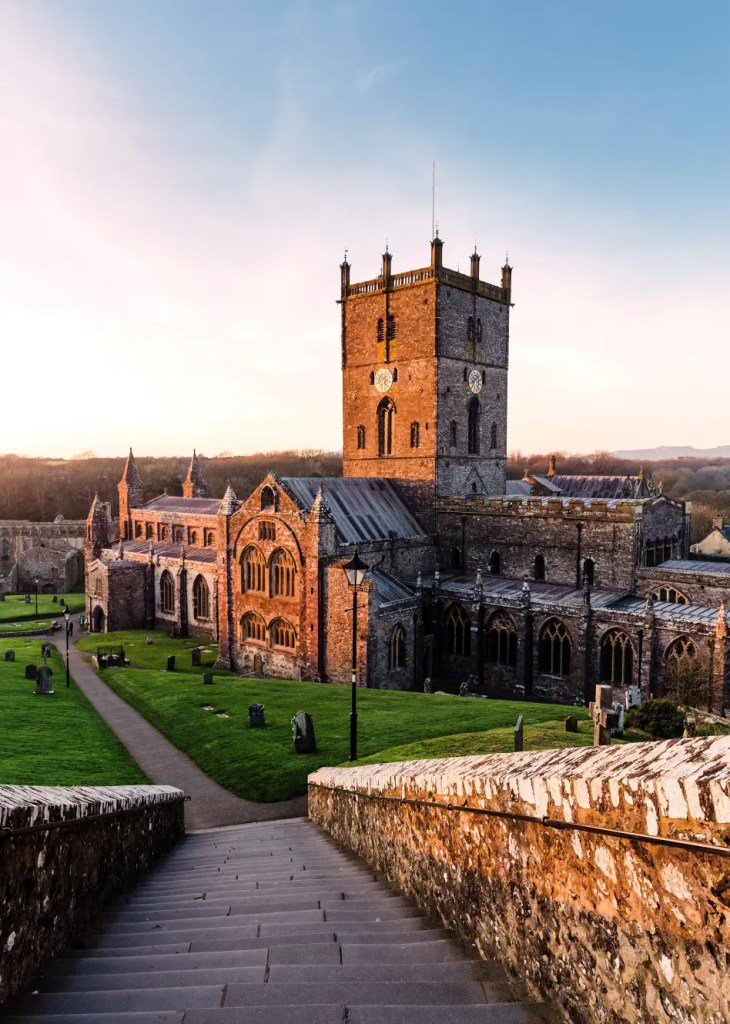
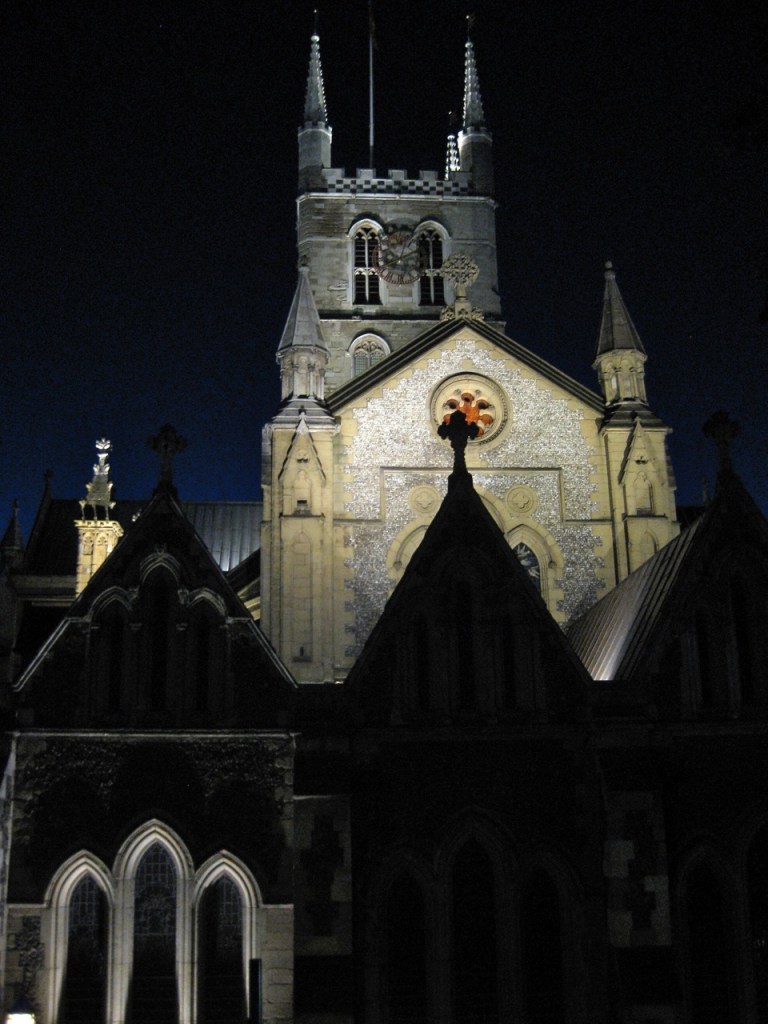
St Davids Cathedral, Pembrokeshire, West Wales

Also, according to legend, he made a pilgrimage to Jerusalem, from which he brought back a stone that now sits in an altar at St. David’s Cathedral, built on the site of his original monastery.

David and his monks lived a simple, austere existence. They ploughed the fields by hand, rather than using oxen. The monks refrained from eating meat or drinking beer. St. David himself consumed only leeks and water. During a battle against the Saxons, he also advised the soldiers to wear leeks in their hats so that they could easily be distinguished from their enemies. It is claimed that, because of one of those two events, the leek became a national symbol of Wales.

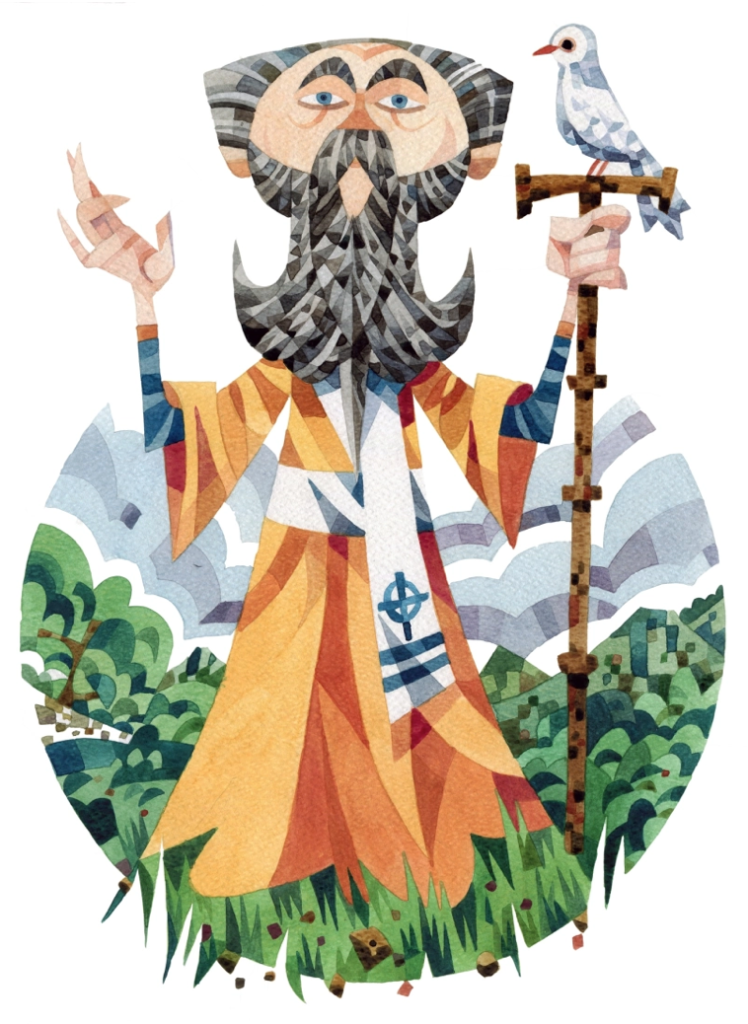
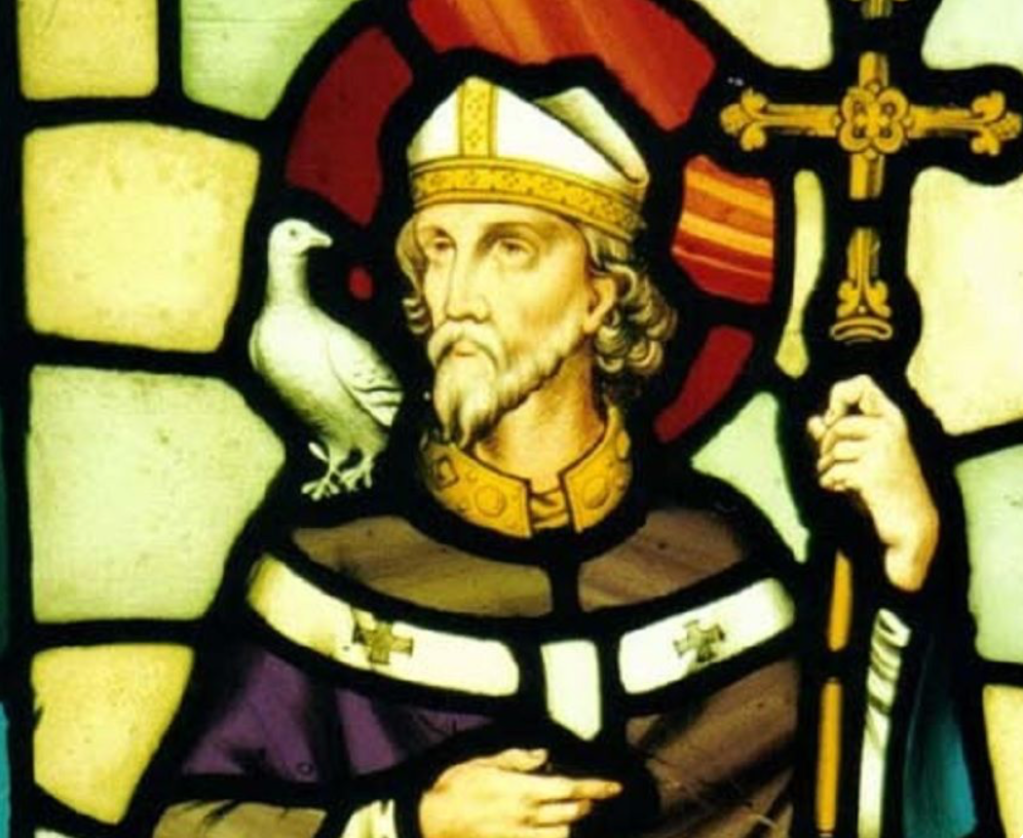
David was said to have performed miracles, the most famous taking place when he was preaching to a large crowd.  People at the back of the gathering complained that they could not hear him. Suddenly, the ground on which he stood rose up to form a hill, allowing everyone to see and hear. Then a white dove (sent by God?) descended to rest on his shoulder.

He died on March 1, in 589, St. David’s Day, and was buried at the site of St Davids Cathedral, where his shrine was a popular place of pilgrimage throughout the Middle Ages. His last words to his followers came from a sermon he gave on the previous Sunday: ‘Be joyful, keep the faith, and do the little things that you have heard and seen me do.’ The phrase Gwnewch y pethau bychain mewn bywyd, ‘Do the little things in life,’ is still a well-known saying in Wales and good advice for us today. 

Collect for St. David

St David, by Jonathan Edwards

Almighty God, you called your servant David to be a faithful and wise steward of your mysteries for the people of Wales. Grant that, following his purity of life and zeal for the Gospel of Christ, we may with him receive our heavenly reward. Amen.

Conversion

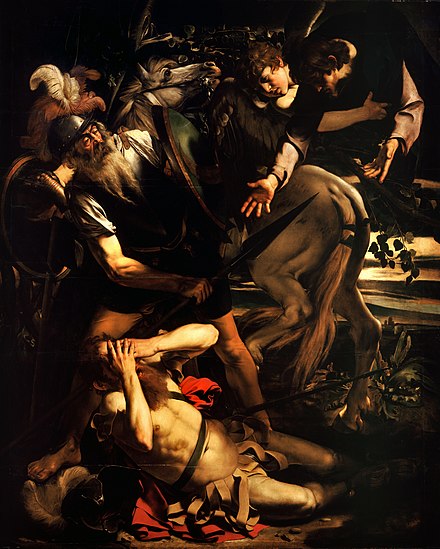
On January 25, the church celebrates the conversion of Paul. His name at the time was Saul of Tarsus, and he was on his way to Damascus to find and arrest in the synagogue the followers of the Way and bring them back to Jerusalem. Acts 9 tells the story. He was blinded by a sudden light and fell to the ground, hearing the voice of Jesus saying, “Why are you persecuting me?”

He was led by his companions to the home of Ananias. In spite of his initial fear for his own safety and that of other Christians in his community, Ananias laid his hands on Saul. Paul (Saul’s new name) immediately regained is sight and was baptized.

The Apostle Paul by Peter Paul Rubens, c. 1611

Paul had been born again, his faith and his life going in an entirely new direction. He stayed with the disciples there for several days and “immediately began to proclaim Jesus in the synagogues.” He went on to become the missionary evangelist of the Way in several countries. His letters to the churches were widely shared, being the first Christian scriptures early believers had then. The Gospels were written decades later. 

The Conversion of Saint Paul by Caravaggio

Some Christians, like Paul, have had a “born again” experience, a dramatic epiphany that prompts a new faith and redirection of one’s life. Others gradually grow into a life of faith through acculturation in a faith community, their own intimate experiences with God, and participa­tion in the sacraments. In either case, true faith is evidenced in the degree to which a person strives to follow the teachings of Christ and to share his love (James 2:14-17). 

Prayer:

O God, who taught the whole world through the preaching of the blessed Apostle Paul, draw us, we pray, nearer to you through the example of him whose conversion we celebrate today, and so make us witnesses to your truth in the world. Amen.

Doubting Thomas

On December 21, the Church celebrates the life of Saint Thomas the Apostle, who sometimes carries the unfortunate nickname of “Doubting Thomas.” 

The Apostle Thomas by Rubens

The Gospel of John tells the story. When Jesus had just explained that he was going away to prepare a heavenly home for his followers and that one day they would join him there, Thomas reacted by saying, “Lord, we don’t know where you are going. How can we know the way?” Jesus responded by saying to him, “I am the way and the truth and the life.”

Thomas was not present when the other disciples first saw Jesus after his resurrection. When he rejoined them, the other disciples told him, “We have seen the Lord.” 

But Thomas said to them, “Unless I see the mark of the nails in his hands and put my finger in the mark of the nails and my hand in his side, I will not believe.”

A week later, Thomas was with his disciples again when, although the doors were shut, Jesus suddenly appeared among them, saying “Peace be with you.” Thomas still didn’t trust his senses. Then Jesus said to Thomas, “Put your finger here and see my hands. Reach out your hand and put it in my side. Do not doubt but believe.” Suddenly Thomas’s eyes were opened and he answered, “My Lord and my God!”

An honest appraisal of one’s beliefs makes room for doubt. Doubt is not unbelief; it is uncertain belief. In 1916 James Snowden defined it as “the borderland between knowledge and ignorance, the twilight between light and darkness.”[1]

He went on to say that not only is doubt not a hindrance to our thinking, but it is a highly useful factor in our knowledge and in life. “Doubt is the great destroyer of error, the scythe that mows down the weeds of baleful beliefs, the scavenger that removes the corpses of false hopes and dead faiths.”

Scriptures are filled with examples of men and women challenging, questioning, and demanding answers from God. I didn’t come to a more mature, deeply held faith until I began to question and wrestle with teaching that didn’t make sense to me. Like the distraught father who brought his epileptic son to Jesus, I could say in my darkest times, “I believe; help my unbelief!” (Mark 9:24).

St. Thomas Cross, Nasrani

Tish Harrison Warren writes that sometimes trusting God feels to her like a steep climb. She writes: “Belief isn’t a feeling inside of us, but a reality outside of us into which we enter, and when we find our faith faltering, sometimes all we can do is fall on the faith of the saints. We believe together.” [2] According to traditional accounts of the Christians in the modern-day state of Kerala in South India, St. Thomas travelled there, outside the Roman Empire, to preach the Gospel, also travelling as far as Muziris and Kodungalloor (in Kerala State) in AD 52. 

He is regarded as the patron saint of India. Many churches in the Middle East and southern Asia, besides India, also mention Apostle Thomas in their historical traditions as being the first evangelist to establish those churches.

According to Syrian Christian tradition, Thomas was killed with a spear at St. Thomas Mount in Chennai (Madras) on 3 July in AD 72, and his body was interred in Mylapore, India.

__________________________________

  1. James H. Snowden, “The Place of Doubt in Religious Belief.” The Biblical World, Vol. 47, No. 3 (Mar., 1916), 151-55, http://www.jstor.org/stable/3142911?seq=1#metadata_info_tab_contents
  2. Tish Harrison Warren, Prayer in the Night. (Downers Grove, IL: InterVarsity Press, 2021), 87.

Stability

On December 5th, the Cornerstone Community in Portland, Oregon, met to install two new members and, for continuing members, to renew their vows. This is the homily from that service: 

In a few minutes, both our new members—who are taking their first vows—and continuing members—who will be renewing their vows—will pledge to work towards Stability, Obedience, and Conversion of Life with the help of our brothers and sisters.

According to Esther de Waal, the vows are not, as they might seem at first glance, about negation, restriction, and limitation.

They are saying Yes to entering into the meaning of our baptism as Christians and into the paschal mystery of suffering and dying with Christ so that we may rise again with him.[1]

Let’s talk a bit about that first vow: the promise of stability. De Waal says stability is fundamental, because it raises the whole issue of commitment and fidelity. Our customary defines stability as “the promise to remain in community, even though close relationships can create interpersonal tensions, and to stay faithful to our practice. There are three facets of stability that are relevant to our lives as monastics: stability of place, stability of practice, and stability of purpose.

Stability of place has unique salience for me. In my young adulthood, as my career was evolving, I moved around a lot. I changed churches frequently. And those changes did not always benefit my emotional or spiritual development. At some point in my mid-20s—I don’t remember exactly when—my habit of daily prayer went away. The habit of greeting God in the morning, setting aside a quiet time for prayer during the day, and saying goodnight to God, giving thanks for the blessings of the day, were no longer part of my daily routine. The religion I practiced on Sunday had little impact on my day-to-day life during the week. 

So, imagine the significance for me of standing in a Cornerstone gathering in January, 2010, and pledging stability at a church where I intended to stay, with a community I loved and people I wanted to be with for the rest of my days. And I learned, in the years since then, that stability of place is a significant factor in stability of practice and stability of purpose.          

Joan Chittister has something to say about stability of place in her commentary on Benedict’s chapter on the type of monks. Responding to Benedict’s description of hermits, Sarabaites and Gyrovagues, those who chose to do their own thing or wandered from monastery to monastery, Sister Joan wrote this: 

“If any paragraph in the rule dispels the popular notion of spirituality, surely this is it. Modern society has the idea that if you want to go away by yourself and ‘contemplate,’ and that if you do, you will get holy.” She continues, “It is a fascinating although misleading thought. The Rule of Benedict says that if you want to be holy, stay where you are in the human community and learn from it. Learn patience. Learn wisdom. Learn unselfishness. Learn love.”[2]

Life in community is central to our practice, even when close relationships sometimes create interpersonal tensions.

     The definition in our customary also has something to say about stability as staying faithful to our practice. Reading the Rule and setting aside time every day to read a little scripture and—most of all—pray has had everything to do with my spiritual health and, I’m sure, yours as well. That practice, as Benedict describes it, includes gathering together with others for worship and participating in the sacraments. The Apostle Paul exhorted the Christians in Jerusalem to “provoke one another to love and good deeds, not neglecting to meet together, as is the habit of some, but encouraging one another, and all the more as you see the Day approaching.[3]

But stability also has to find a place in one’s heart—one’s sacred purpose. Esther de Waal makes the point that stability relates primarily to persons and not only to place. At the heart of stability there is the certitude that God is everywhere, that if we can’t find God in our present circumstances, we won’t find Him anywhere, because the kingdom of God begins within us. God is our center of gravity.

De Waal uses the analogy of a newly pregnant woman. She goes about her daily business with the only difference between her and others around her is her quiet knowledge that she is carrying a child. She carries that secret life around within her, and the mystery of this, which applies to both men and women, is that it is totally there whatever the external circumstances.

One definition of stability relates to mathematics, specifically to probability distributions that retain their integrity in spite of occasional outliers or anomalies. I don’t know about you, but my actions and behaviors certainly have their occasional outliers and anomalies. Will we fail from time to time? Most certainly. But we carry on because we have that seed within us that tells us who we are and to whom we belong. 

In times of rapid social change, stability takes on particular relevance for us. Those of us who are Trinity members are entering a nervous time of transition as we think about finding a new dean. In addition, our recent national election and uncertainty about new leadership have created much anxiety in many of us. Let’s be mindful that those both within and outside our church communities will be looking to us for stability as we enter into perilous—possibly dark—times ahead in our world, remembering that darkness isn’t entirely a bad thing. It is in the darkness that one notices the light. And we are called to be that light to the world. 

Stability does not imply passivity. In our mobile culture we cannot always guarantee stability of place. We have two members that live in a different country, and we have had members that have moved away because of work or family. But we can pledge to continue our practice, with God’s help, where we are planted, and to give our heart to God’s purpose, with courage and perseverance.

Paul uses the analogy of spiritual warfare. In his letter to Timothy, he says,

“Pursue righteousness, godliness, faith, love, endurance, gentleness. Fight the good fight of the faith; take hold of the eternal life to which you were called and for which you made the good confession in the presence of many witnesses.”[4]

The teacher and therapist Prentis Hemphill talks about stability of purpose and names courage as an essential element. As we look at the world around us, it is clear that we are called to be instruments of change. But, according to Hemphill, it will not happen without risking something of ourselves, perhaps by seeing ourselves honestly and stepping up when God calls us to action. “The courage we need is the courage to fail and stay,” says Hemphill. “The courage to reimagine every aspect of our social relations. . . The courage to reach for one another. The courage to be honest. The courage to ask questions. The courage to listen. The courage to feel uncomfortable. The courage to be a part of the circle, to be fed by and to feed. The courage to surrender . . . The courage to love and be loved.”

Until Sunday night, I wasn’t sure how I wanted to end this homily. Those of you who attended Trinity’s Advent Lessons & Carols heard, with me, this powerful poem by Marie Howe, inspired by the angel’s annunciation to Mary. It moved me because it instantly made me remember my own calling when I joined this community: 

Annunciation
by Marie Howe
Even if I don’t see it again—nor ever feel it
I know it is—and that if once it hailed me
it ever does—
And so it is myself I want to turn in that direction
not as towards a place, but it was a tilting
within myself,
as one turns a mirror to flash the light to where
it isn’t—I was blinded like that—and swam
in what shone at me
only able to endure it by being no one and so
specifically myself I thought I’d die
from being loved like that.


So, brothers and sisters in Christ, carry on. Fight the good fight. Be the light that the world needs.


[1] Esther de Waal, Seeking God. (Collegeville, MN: Liturgical Press, 1984), 55.

[2] Joan Chittister, The Rule of Benedict: Insight for the Ages. (New York: Crossroad, 1992), 33. 

[3] Heb. 10:24-25

[4] 1 Tim. 6:11-12
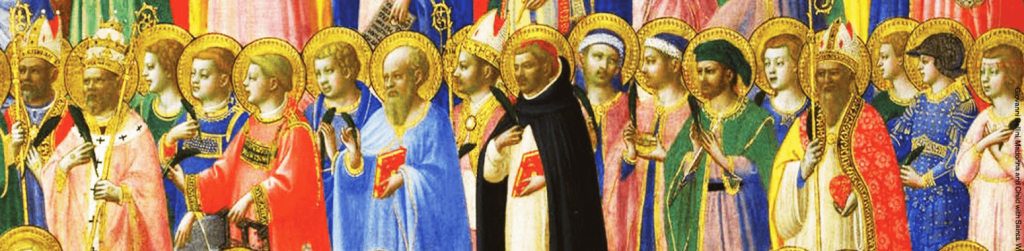
All Saints

From the Rule of St. Benedict: “On the feasts of Saints and on all festivals let the Office be performed as we have prescribed for Sundays, except that the Psalms, the antiphons and the lessons belonging to that particular day are to be said. . .” (Chapter 14)

From Praying with Saint Benedict:

Benedict instituted a practice that is still observed today: that is, the use of special. scriptures and psalms in honor of the saint who is celebrated on that day as a departure from the regular lessons that would usually be used. The number of psalms, lessons, and antiphons remains the same, but different ones, suggested specifically for their connections to the life of the commemorated saint, are read.

No standard criteria for honoring saints existed in Benedict’s time. Instead, local dioceses declared saints who should be honored. Centralization of the process of declaring saints occurred within the Roman church by Pope Gregory IX in 1234. Before then, the principle in effect for designating someone as a saint was that Christ should be known more intimately through the person honored, and that the holiness of the person was evident in their Christian practice and the inspiration for those around them to act likewise.

As someone who was not raised in a liturgical tradition, celebration of saints was a new concept for me. I have enjoyed learning about the lives of these exemplars whose extraordinary faith and service serves as an inspiration to us today.

The words of the hymn remind me that not all saints are in heaven. They are among us today. “By saints below and saints above, the Church in earth and heaven.” 

Ephesians 3:18-19 I pray that you may have the power to comprehend, with all the saints, what is the breadth and length and height and depth, and to know the love of Christ that surpasses knowledge, so that you may be filled with all the fullness of God.

Seeds of Contemplation

From Thomas Merton (1961)

Every expression of the will of God is in some sense a “word” of God, and therefore a “seed” of new life. . .

In all the situations of life the will of God comes to us not merely as an external dictate of impersonal law but above all as an interior invitation of personal love. . .

If these seeds would take root in my liberty, and if His will would grow from my freedom, I would become the love that He is, and my harvest would be His glory and my own joy.

I must learn therefore to let go of the familiar and the usual and consent to what is new and unknown to me. I must learn to leave myself in order to find myself by yielding to the love of God. If I were looking for God, every event and every moment would sow, in my will, grains of His life that would spring up one day in a tremendous harvest.

Excerpted from Thomas Merton, New Seeds of Contemplation. (New York: New Directions, 1961), 14-17.

Thanks to Ron Walker for sharing this.

Improbable Saint

Rubens, Apostel Mattheus

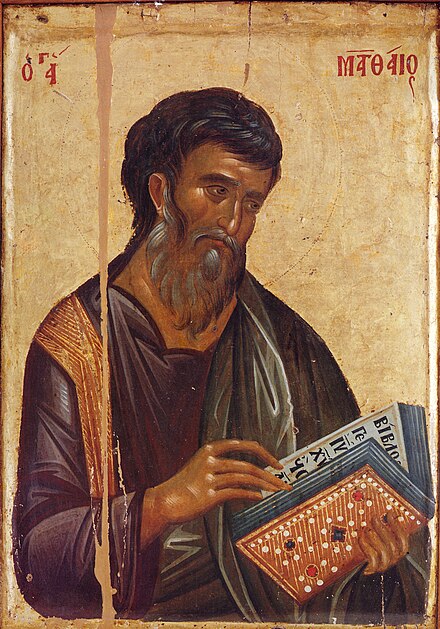
Early Church tradition holds that the first book of the New Testament was written by the apostle Matthew. Although later scholars have disputed the claim, his authorship was first attested among the writings of the first and second centuries by the early Christian bishop Papias of Hierapolis.  The Gospel of Matthew identifies Matthew as a tax collector. Tax collectors were among the most despised individuals in Judea, being agents of the Roman government and often greedy and dishonest in their dealings. But then again, Jesus called a variety of improbable men to be his disciples, including several scruffy fishermen who were also among the lowest rung of Jewish society. 

Several years ago, on a trip to Italy, I found myself standing in San Luigi dei Francesi Church in Rome, looking at a painting by Caravaggio, La Vocazione di San Matteo (The Calling of Saint Matthew). In the painting, Matthew, the tax collector, sits at a table in the customs house, counting coins with two other men as two well-dressed boys sit with them, looking on. The light from a high window bathes their faces as the men turn toward the interruption at the entrance to the room.

At the door, the figure of Jesus, par­tially silhouetted by the light behind him and partially obscured by Saint Peter standing in front of him, points toward Matthew. Matthew points a finger at himself and a quizzical look crosses his face, as if he’s saying, “Who, me?” The painting represents a man caught between two worlds and portrays an encounter with Christ that begins a per­sonal transformation.[1]

What resonated with me (and, I think, must have resonated with Caravaggio) was the unexpected nature of Christ’s call, for Matthew as well as for me in my own call to lay ministry. Rachel Held Evans wrote that what is most annoying and beautiful about the Holy Spirit is that it has this habit of showing up in all the wrong places and among all the wrong people. [2] However, when Christ comes to us, we are compelled to look up from what we are doing, listen with the ear of our heart, and follow.

Church tradition tells us that Matthew died as a martyr in Ethopia. The church celebrates him on September 21st

  1. Excerpted from S. Isaacson, A Confirmation of Faith. (Eugene: Wipf & Stock, 2021), 73-74.

2. Rachel Held Evans, Searching for Sunday. (Nashville, TN: Nelson, 2015), 197.

Good Zeal

From Chapter 72 of the Rule: “Just as there is an evil zeal of bitterness which separates from God and leads to hell, so there is a good zeal which separates from vices and leads to God and to life everlasting. This zeal, therefore, the monks should practice with the most fervent love.” 

And Romans 12 tells us “Do not lag in zeal, be ardent in spirit, serve the Lord. Rejoice in hope, be patient in suffering, persevere in prayer. Contribute to the needs of the saints; extend hospitality to strangers.”

There is zeal and then there is zeal, so it seems. The Bible is full of all kinds of examples. Elijah, in his zeal, killed all the prophets of Baal. Afterward, God spoke to him, asking, “What are you doing here?!”, and Elijah answered, “I have been very zealous for the Lord, the God of hosts” (1 Kings 19). King Saul tried to wipe out the Gibeonites in his zeal for the people of Israel and Judah. In his zeal for the Hebrew law, Paul was a persecutor of the early church (Phil. 3). Terrible atrocities today are a result of religious zeal.

Benedict goes on in this Chapter 72 to make a distinction between good zeal and bad zeal, and he makes clear that the critical factor in good zeal is love. We should be zealous in showing respect, patiently supporting each other, and obedience to the community. In Paul’s letter to the Romans, he advocates being zealous in mutual affection, service, and ministry to the poor. Zeal involves hating what is evil and holding fast to that which is good.

I can think of zealous people in my life who, motivated by their faith, are quick to visit the sick, feed those who are hungry, show affection to others, and live in harmony with those who are different from them in beliefs and values. These brothers and sisters should be our teachers.

Most importantly, Benedict admonishes us to prefer nothing whatever to Christ, our ultimate example, who brings us all to everlasting life.

___________________________

From Praying with Saint Benedict (New York: Morehouse, 2021), 196-7.