Mike and I just spent three weeks in France. On the last Sunday of our vacation in France, my Cornerstone sister Judy took us to Taizé, an ecumenical monastic community in rural Burgundy, currently comprised of about 80 brothers: Catholic, Anglican, Protestant, and Orthodox men from about thirty countries around the world. The community was founded by Brother Roger Schutz in 1940 as a refuge from those escaping war.
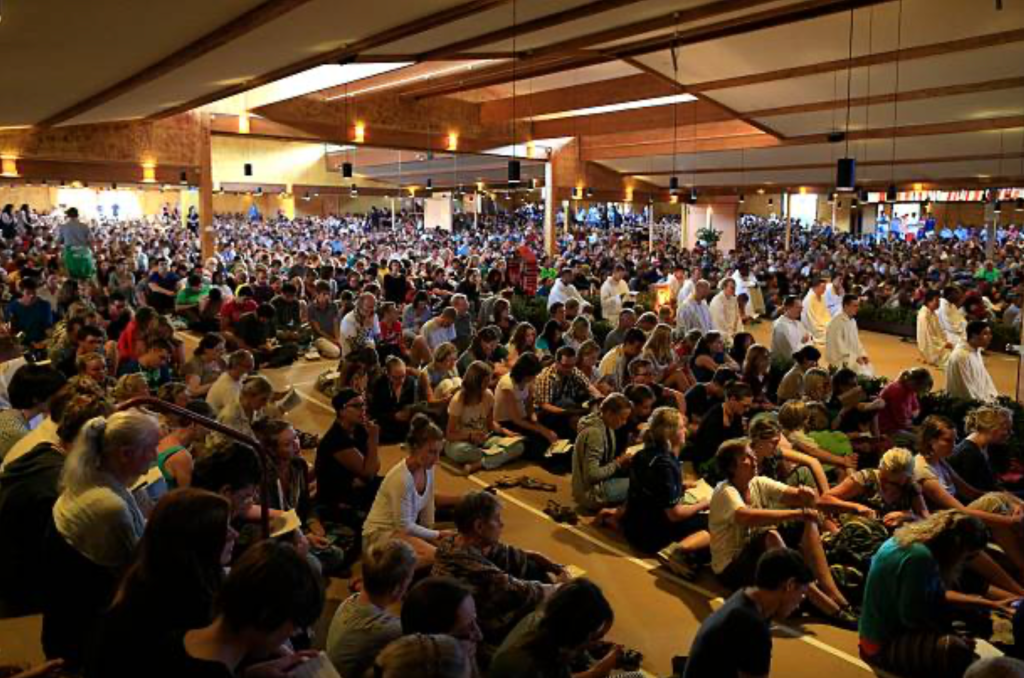
As one website says, “the Taizé community promotes Christian unity and reconciliation through prayer, work, and hospitality,” what Br. Roger called a “parable of communion.” Although it is best known for its music, the community’s principal aim has always been to live out the Gospel in ministry to the poor and love for their neighbor.
It has become a global phenomenon, especially popular with young people. Hundreds—and on special occasions, thousands—of people flock to its services or come for week-long retreats.
Driving up to the sprawling worship building, the Church of Reconciliation, a wooden structure that has been gradually expanded through the years, I was impressed by its simplicity after seeing many grand Gothic and Romanesque churches in the region.
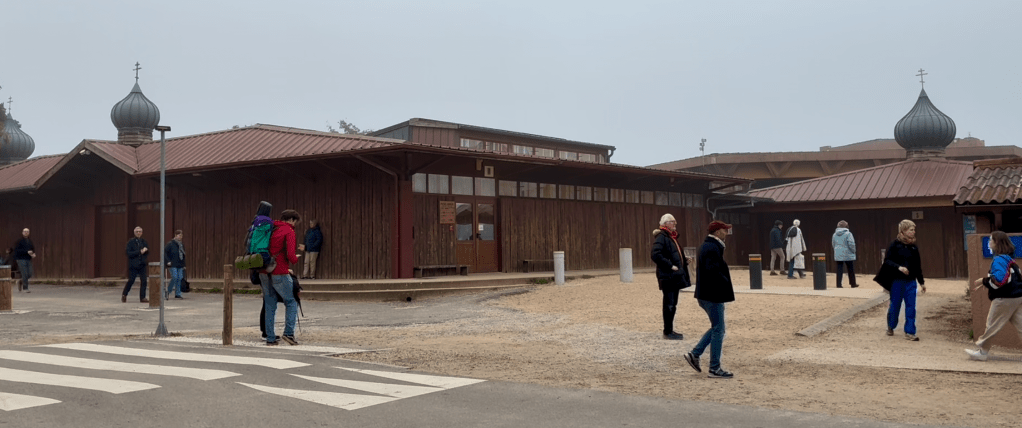
As bells were ringing, people quickly filed in for the ten o’clock Eucharist service.
Entering the sanctuary, I was stunned by the beauty of the place. At the top of the brightly-colored walls were simple stained-glass clerestory windows, and soft lighting and silence contributed to the sense of a sacred space. Most worshipers sat cross-legged or knelt on the carpeted floor, the white-robed monks kneeling in a wide center aisle. We sat on the steps at the side of the space. Side benches also were provided for those who needed them.

Worship roughly follows the customary format for liturgical worship and consists primarily of chants in Latin and sometimes several other languages.
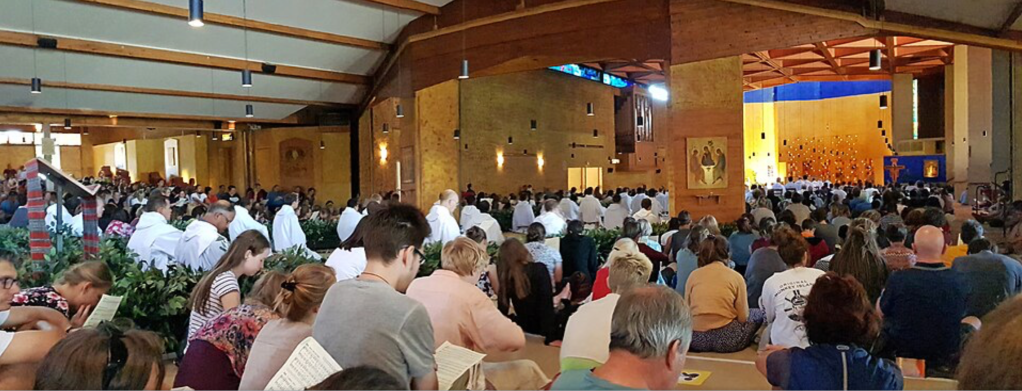
Hearing hundreds of people sing the repetitious chants, most often in four-part harmony, was exceptionally beautiful. Though many are sung a capella, some are accompanied by an excellent guitarist and keyboardist. Sometimes the last note of a refrain is held as a soloist sings a verse, over the harmonic hum, then everyone joins in the repeated refrain. The scripture lessons are read in two, sometimes three, languages. At the end of the spoken prayers, worshipers sit in complete silence for about ten minutes of contemplative prayer. Because of the large number of people, the brothers and lay Eucharistic ministers bring the bread and wine to several stations throughout the space during communion.

I found the service extremely moving. The Holy Spirit was there. The German woman sitting next to me was in tears, and I fought back tears as well. It was one of the most pure worship experiences I have ever had. No sermon was given, but God spoke to me nonetheless.
 Improbable Benedictine
Thank you for sharing the pictures and experience of this sacred community.
Carolyn A
LikeLike