
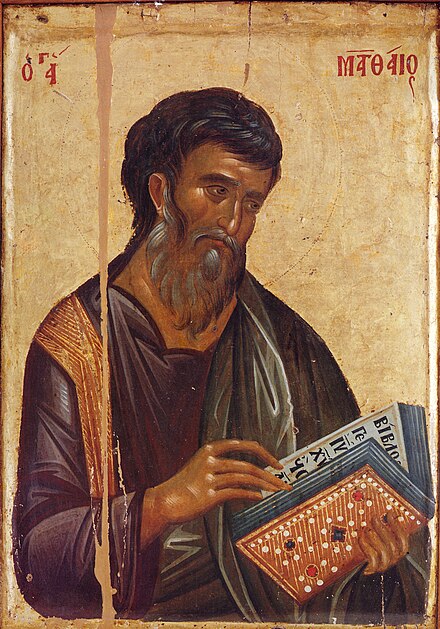
Early Church tradition holds that the first book of the New Testament was written by the apostle Matthew. Although later scholars have disputed the claim, his authorship was first attested among the writings of the first and second centuries by the early Christian bishop Papias of Hierapolis. The Gospel of Matthew identifies Matthew as a tax collector. Tax collectors were among the most despised individuals in Judea, being agents of the Roman government and often greedy and dishonest in their dealings. But then again, Jesus called a variety of improbable men to be his disciples, including several scruffy fishermen who were also among the lowest rung of Jewish society.
Several years ago, on a trip to Italy, I found myself standing in San Luigi dei Francesi Church in Rome, looking at a painting by Caravaggio, La Vocazione di San Matteo (The Calling of Saint Matthew). In the painting, Matthew, the tax collector, sits at a table in the customs house, counting coins with two other men as two well-dressed boys sit with them, looking on. The light from a high window bathes their faces as the men turn toward the interruption at the entrance to the room.

At the door, the figure of Jesus, partially silhouetted by the light behind him and partially obscured by Saint Peter standing in front of him, points toward Matthew. Matthew points a finger at himself and a quizzical look crosses his face, as if he’s saying, “Who, me?” The painting represents a man caught between two worlds and portrays an encounter with Christ that begins a personal transformation.[1]
What resonated with me (and, I think, must have resonated with Caravaggio) was the unexpected nature of Christ’s call, for Matthew as well as for me in my own call to lay ministry. Rachel Held Evans wrote that what is most annoying and beautiful about the Holy Spirit is that it has this habit of showing up in all the wrong places and among all the wrong people. [2] However, when Christ comes to us, we are compelled to look up from what we are doing, listen with the ear of our heart, and follow.
Church tradition tells us that Matthew died as a martyr in Ethopia. The church celebrates him on September 21st.
- Excerpted from S. Isaacson, A Confirmation of Faith. (Eugene: Wipf & Stock, 2021), 73-74.
2. Rachel Held Evans, Searching for Sunday. (Nashville, TN: Nelson, 2015), 197.
 Improbable Benedictine
really? I’ve always heard Mark was the 1st of the gospel writers. SU needs to correct this if not true. Right? My favorite teacher was a Marken scholar.
LikeLike
Yes, Mark was the first author to write a Gospel account. Matthew’s gospel is the first in the order in which they now appear in the NT.
LikeLike