Sunday, May 28
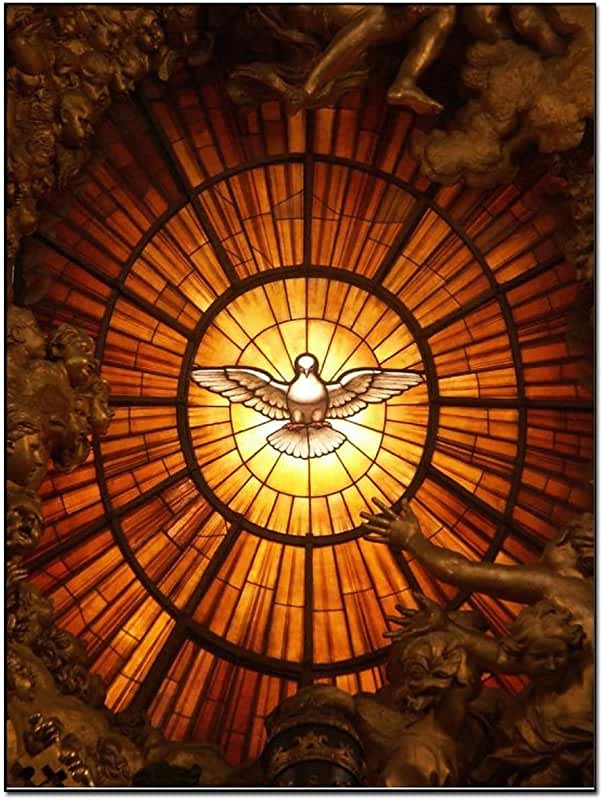
This Sunday we celebrate Pentecost, that extraordinary event when, after Christ’s ascension, the followers of The Way were gathered in one place. They heard a sound like a violent wind and saw what seemed to be tongues of fire that came to rest on each of them. They were filled with the Holy Spirit.
Today the Holy Spirit most often comes to us in a less dramatic fashion. You may be singing a familiar hymn in church, and suddenly you are moved by the words that suddenly have a deeper meaning than you realized previously. Perhaps you are sitting in a parish committee meeting and you all sense a spirit of consensus and the assurance that the decision you have reached together is in keeping with God’s will. You are listening to a sermon or a guest speaker at a Sunday forum, and you have the feeling that the speaker’s words were intended for you and were exactly the thing you needed to hear. You are sitting by a river in a beautiful valley and are overwhelmed by the beauty of the place and the sense of God’s presence. You wake up thinking about someone in need and feel compelled to call or visit that person.

Richard Rohr describes the Holy Spirit as that aspect of God that works secretly, largely from within at the deepest levels of our desiring. It is an inner compass, a “homing device” in our soul, “an implanted desire that calls us to our foundation and our future.” [1]

The signs of the Spirit I have learned to look for and have come to appreciate are what Paul referred to as the “fruit of the Spirit”: love, joy, peace, patience, kindness, generosity, faithfulness, gentleness, and self-control (Gal. 5:22-23). Benedict enjoins us, in everything we do, to offer it to God “with joy of the Holy Spirit.[2]
And, of course, we recognize instantly that to live this way consistently, every day of our lives, is impossible through our own efforts. Nadia Bolz-Weber reminds us that God’s work in the world has always been done through sinners.[3] We take on this challenge of living a holy life with a vision of what it means—as Benedict puts it—to dwell in God’s tent, understanding that it is the Holy Spirit working in us that keeps that vision alive and propels us along our spiritual path.
- Richard Rohr, Falling Upward. (San Francisco: Jossey-Bass, 2011), 88-90.
2. RSB 49, Part 1
3. Nadia Bolz-Weber, Accidental Saints (New York: Convergent Books, 2015), 203.
 Improbable Benedictine
Steve – this message resonates with me as I often find myself caught up, as you write, by a moment when some part of a sermon or program note strikes me at just the right moment, letting me know that “all is well”. Well said! Holly
LikeLike
Beautiful meditation on Pentecost and the Holy Spirit. Thank you.
Carolyn Aichele
LikeLike